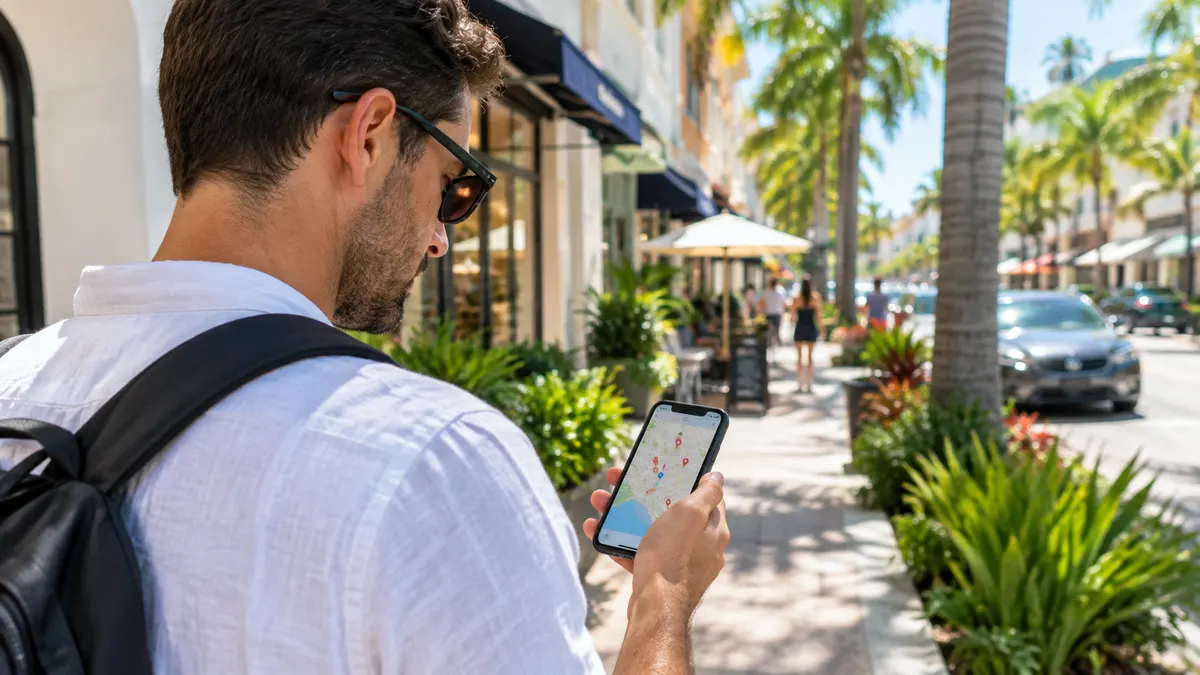
Open Google on your phone and search "dentist in Coral Gables." Or "employment lawyer in Miami." Or whatever service you offer, followed by your city.
Do you show up?
If the answer is no, there's a concrete problem: every time someone searches for exactly what you sell in the city where you operate, that customer is going to whoever does show up. Not because they're better than you. Simply because Google shows them and not you.
That's what local SEO fixes. And no, it's not a complicated concept, and you don't need to be a tech expert.
Local SEO, in plain words
Local SEO is what makes your business show up on Google when someone searches for your service near where you are. That simple.
When someone searches "dentist near me" or "English academy near Brickell," Google shows two things: a map with 3 featured businesses (the well-known Local Pack) and, below it, the regular organic results. If you're not in either one, you don't exist for that customer.
The difference with "regular" SEO is that local SEO works with geographic signals: your location, the searcher's location, your Google listing, your reviews, and whether your website naturally mentions where you operate and what you do there.
Why this is an opportunity in Miami (not a problem)
In bigger, more saturated markets, local SEO is already crowded: more businesses with optimized listings, more agencies working on rankings, more reviews stacked up. In plenty of pockets of the Miami area, service businesses still haven't taken their Google presence seriously — and that varies block by block, neighborhood by neighborhood, from Brickell to Kendall to Doral.
That means the window of opportunity is open. While your competitors depend on word-of-mouth and Instagram, you can rank on Google Maps with a well-built listing and a website that answers local searches. You're not competing against national giants — you're competing against businesses in your own area that, in most cases, don't even have a claimed listing.
The 3 factors Google uses to decide who shows up
Google says this openly. Local ranking comes down to three things:
Relevance: how well your listing and your website match what the person is searching for. If someone searches "dermatologist" and your listing just says "medical clinic" with no specifics, you lose relevance. The right category, detailed services, and a clear description make the difference.
Distance: how close you are to the searcher. You don't control this one (you're not moving your office). But you control the other two, and a well-optimized business can outrank a closer one if its listing and website are more relevant and prominent.
Prominence: how well-known and well-reviewed your business is online. This is where reviews come in (quantity, quality, frequency), links to your website, directory mentions, and your site's authority. A business with 47 reviews at 4.8 stars beats one with 3 reviews at 5 stars.
The minimum you need to get started
You don't need to hire an agency to take the first step. You can do these 5 things yourself this week:
1. Create or claim your Google Business Profile. It's free. If you search your business on Google and a listing shows up that you don't control, claim it. If nothing shows up, create it from scratch. Fill out every single field: exact business name, address, phone number, hours, primary category, secondary categories, services, description.
2. Get real reviews. Not bought, not fake. Ask happy customers to leave you a Google review. The most effective way: send a direct link over WhatsApp right after you finish the job. Respond to every review — the good ones and the bad ones.
3. Make sure your website mentions your city. If your site says "we're a professional services company" without mentioning Miami anywhere, Google has no way to connect you with local searches. Mention your city naturally in your content, not forced.
4. Your name, address, and phone number need to match everywhere. Google cross-references your listing with your website, directories, and social media. If one place says "123 Main St" and another says "123 Main Street" and a third has an old phone number, Google loses confidence in you. Stay consistent.
5. Upload real, current photos. According to Google, businesses that share photos get significantly more direction requests and calls. Photos of your location, your team, your work — real, not stock.
Your website and your listing don't compete — they need each other
A common mistake is thinking that having a Google listing is enough and you don't need a website, or the other way around. In practice, they work together:
- Your listing gets you on the map and gives you instant visibility.
- Your website tells Google, in more depth, what you do and for whom — and gives your visitor a place to become a contact (form, WhatsApp, booking).
- Your listing's reviews build trust.
- Your website's content builds relevance.
Businesses that work on both — an optimized listing plus a website with local SEO — have a real edge over the ones with only one. If you've already taken these 5 steps and want to take it further, here's how we do it at SURCA.
The number that should get your attention
The vast majority of local searches now happen on mobile. And close to half of all Google searches carry local intent. That means there's someone in the Miami area, right now, searching for exactly what you sell. The question is whether they find you or your competitor.
Frequently asked questions
How much does local SEO cost?
Google Business Profile is free. Optimizing your listing, requesting reviews, and adjusting your website doesn't require ad spend. What it requires is time, consistency, and a well-built website.
How long does it take to work?
Some businesses see results in 4 to 8 weeks with a well-optimized listing and fresh reviews. In more competitive industries, it can take 3 to 6 months. But unlike paid ads, the results stick around without you continuing to pay.
Do I need to pay for Google Ads to show up on the map?
No. The Local Pack is an organic result, not a paid one. It's earned with an optimized listing, good reviews, and a relevant website.
What if my business doesn't have a physical location?
You can set up your listing as a service-area business, defining the areas you serve without showing a physical address. Works for professionals who go to the client: plumbers, mobile attorneys, consultants, and similar.
Are Google Business Profile and Google My Business the same thing?
Yes. Google changed the name in 2022. If you see references to Google My Business anywhere, it's the same tool: your free business listing on Google Maps.
Want your business to show up when people search for you in Miami? At SURCA we build lead-capture systems with local SEO built in: an optimized listing, a website that ranks, and metrics from day one. Request a free diagnosis and we'll show you where you stand on Google today and what you can improve.